A completion bond is a guarantee, from a specialist company, that a film will be delivered to its financiers on budget and on schedule — or the guarantor will finish it, fund the overrun, or repay the money. Lenders and agencies that finance independent film almost never advance funds without one; Screen Australia, the Australian government screen agency, states in its production funding guidelines that a completion guarantee is a standard requirement of its finance. The Showbiz Clinic publishes information, not investment advice.
The business is old and concentrated. Film Finances, generally credited as the industry's pioneering completion guarantor, was founded in 1951 and remains one of a small group of companies — alongside a handful of rivals — that underwrite the majority of the world's bonded independent films, per the company's published corporate history.
Who Buys a Completion Bond and What Does It Cover?
The borrower pays, effectively. The producer arranges the guarantee and pays a fee — commonly in the low single digits as a percentage of budget — but the real client is the lender, the sales agent and every party that advanced money against delivery. Coverage is delivery, not quality and not commerce: the bond promises a finished, contractually conforming film, not a hit, and not even a good one.
That distinction drives everything. The guarantor underwrites the screenplay, the schedule, the budget, the key personnel and the financing plan before committing. Its analysts look for the classic failure points: schedules with no weather cover, budgets with no contingency, first-time directors paired with ambitious scope, financing plans where two parties think they own the same collateral. A bond company declines far more projects than it quotes.
What the bond does not cover is as instructive. It does not insure against a distributor going bankrupt after delivery, against a film being commercially unsuccessful, or against disputes over creative intent. If a director wants three more weeks for tone and the schedule says the film is deliverable, the guarantor will typically rule for delivery — its obligation ends at the contract, not the vision.
What Happens When a Production Runs Over Budget?
The guarantor takes control, in the worst cases. A completion company facing a serious overrun can, under the standard terms of its guarantee, step in and take over production — replacing a director, a line producer or an entire department — because it has promised financiers delivery and its own capital is now at risk. Takeover is rare; the threat of it disciplines every set the industry runs.
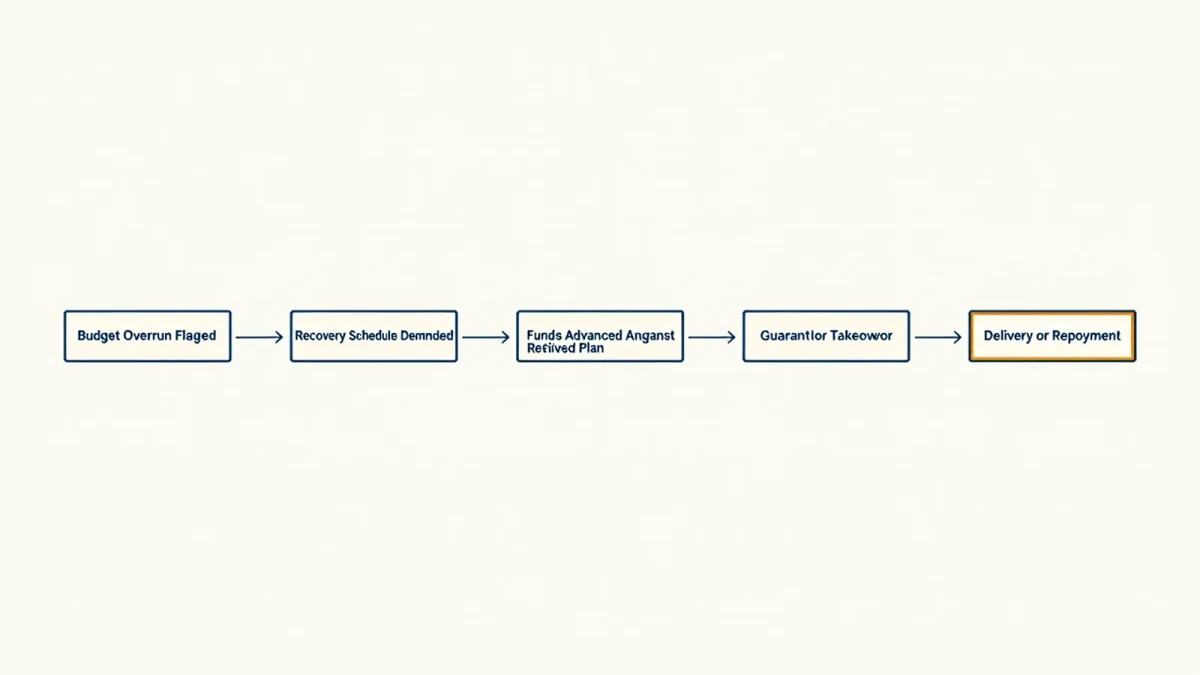
The escalation usually runs in stages. First the bond company demands a recovery schedule showing how the production returns to budget; then it may advance funds against a revised plan, secured by the producer's rights and future fees; only when no credible plan exists does it seize the picture. Most overruns end at stage one, quietly, with the producer's fees and collateral deferred to protect the guarantor's position.
Financiers accept this regime because it converts their worst-case exposure into a managed process. Without a bond, a mid-production collapse strands a bank holding half a film with no market value — footage, not a product. With a bond, a counterparty with deep reserves and a reputation for delivery stands behind the finish line, and that promise is what lets banks lend against presales at all.
Streaming complicated the guarantee slightly. Platforms commissioning originals often self-finance and absorb delivery risk the way studios always have, so the bond market remains concentrated where borrowed money still rules: independent features, international co-productions and television at scale. When platforms buy finished films at festivals, the bond's job ended at delivery — one more quiet way the streaming era rewired who carries which risk.
Why Are There So Few Completion Guarantors?
Because the tail risk is savage and the Rolodex is everything. A guarantor needs production executives who can land a faltering shoot in any genre and any territory, relationships with every bank and sales agent in the market, and reserves to fund multiple simultaneous overruns. Bonding ten mid-budget films means being long ten correlated bets on weather, health and human behavior — and one takeover gone wrong can erase years of fee income.
Consolidation has thinned the field further. The major guarants have absorbed or outlasted smaller rivals, and several have added related lines — insurance broking, servicing, collections — to smooth the revenue. Producers complain about concentrated pricing power; lenders consider the concentration a feature, since a guarantor's name is the credit being underwritten.
How Do Bond Companies Price Risk?
Through interrogation, not actuarial tables. There is no meaningful loss history for a specific director's third act, so underwriting is forensic: schedule realism, contingency size of the budget — the industry convention hovers around 10 percent — cast insurability, completion of key elements, and the financing plan's integrity. A genre with predictable shooting demands prices cheaper than one dependent on children, animals, weather or water.
The fee is also not the whole cost. Producers surrender control rights they would otherwise keep: the guarantor approves the budget and schedule, holds sign-off on key hires, and can demand security over the film's rights. A bond is a bargain in which the producer sells optionality — the freedom to overrun — to make other people's money available. Most productions make that trade without hesitation, because the alternative is no production.
Claims and disputes have their own protocol. When delivery is late or a delivered film misses contractual specifications — missing dubbing tracks, unresolved music clearances, technical QC failures — financiers make a claim and the guarantor investigates and settles. Claims are less dramatic than takeovers but far more common, and the settlement currency is usually money or completed work, not headlines. The bond company's claims record is its real balance sheet.
One caveat completes the picture: a bond protects the finance plan, not the film's commercial fate. Guarantors have delivered pictures into distribution collapses and delivered flops on time and on budget, honoring the contract both times. The product is certainty of completion — and in a business built on manufactured uncertainty, that narrow promise is worth an entire fee schedule.
What Should Investors Read Into a Bond's Presence?
Diligence, outsourced. A completion guarantee signals that a specialist firm with its own capital at risk has interrogated the schedule, the budget and the people, and declined to walk away. It is not a seal of quality or of profitability — bond companies have finished plenty of unreleasable films — but it is the closest thing independent film has to an underwriter's stamp.
The wise reading is layered. A bonded film with a bank, a sales agent and a rebate in place has passed three separate adversarial reviews before principal photography. An unbonded one has, by definition, passed none — which is either a studio's balance sheet or a lottery ticket, and an investor should know which they are holding.