A movie gets financed by stacking presales, tax rebates, gap debt and private equity into one structure, then making the pieces cover each other's risk. On a $10 million independent film, a producer can routinely assemble more than half the budget from soft money and territorial advances before writing an equity check — and the equity that goes in last gets paid back first, which is exactly why everyone fights over position. The Showbiz Clinic publishes information, not investment advice.
Studio films work differently: a Disney or a Universal simply funds production from its own balance sheet and answers to shareholders. Everything below is about the independent model, where the financing plan is the business.
What Are the Main Sources of Film Financing?
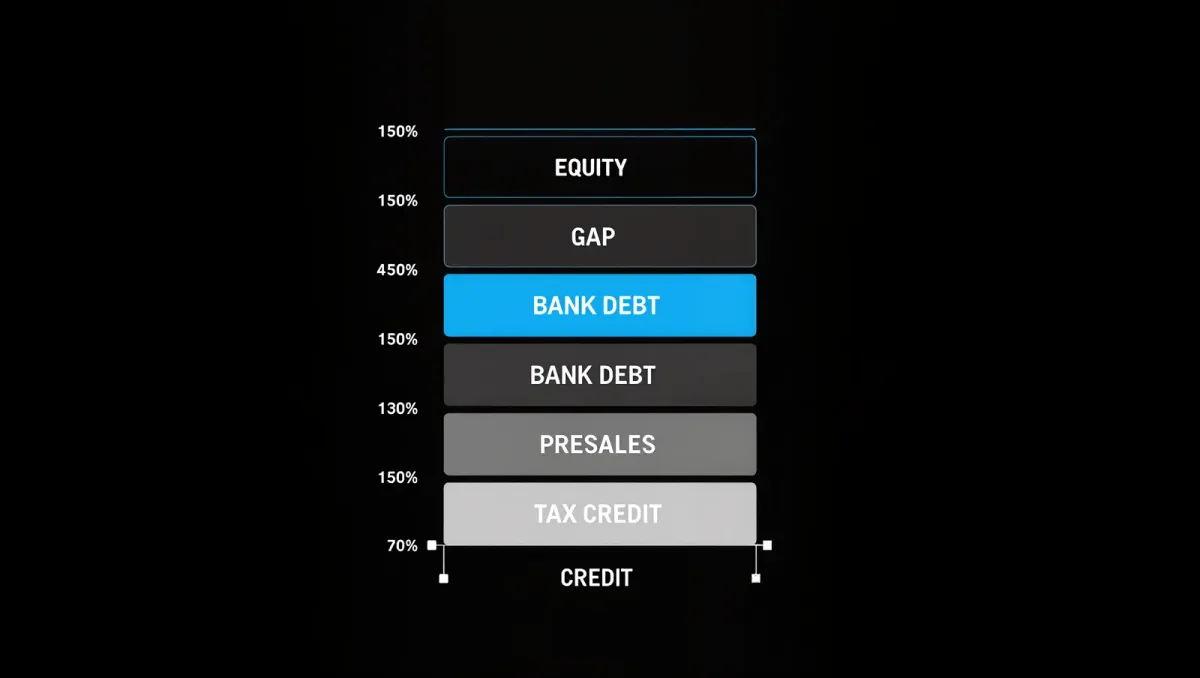
Four buckets fund most independent films: presales of distribution rights, tax incentives and rebates, debt secured against those two, and equity at the top. A fifth — producer deferrals and talent backend — functions as invisible financing, because money not paid today is money the film did not have to raise. The mix shifts with budget level, genre and cast.
Presales came to define the independent boom of the 1990s. A producer sells the right to distribute the film in Germany or Japan before it exists, takes a minimum guarantee as an advance, and assigns that contract to a bank. The bank lends against it, typically at a discount. The system collapsed with the territory buyers who overpaid for it in the early 2000s, and today only a handful of markets reliably pre-sell — but the mechanism still anchors international financing.
Equity is the most expensive money in the stack. It sits first in the waterfall for recoupment precisely because it is last in certainty, and it demands a premium: a defined overage position, sometimes participation in profits, always a seat near the ledger. Films that lean too hard on equity hand the upside to strangers; films that lean too hard on debt hand the downside to the bank.
How Do Tax Rebates and Incentives Reduce the Budget?
Soft money routinely covers 20 to 40 percent of an independent budget. Georgia's film tax credit returns 20 percent of qualified spend with no annual cap, per Reuters' coverage of the state program, and a stacked 10 percent uplift for certain promotional elements — which is why Atlanta became a production capital rather than a punchline.
California runs the opposite design: a capped annual appropriation of $330 million, administered under the state's film and television tax credit program, per the California Film Commission, awarded by lottery and aimed at pulling production back from Georgia and New York rather than subsidizing everything. Caps change behavior. When the California queue fills, mid-budget films move states the way crews move stages.
The mechanics matter as much as the percentages. A transferable credit can be sold to a taxpayer for cash, effectively monetizing a rebate the production itself cannot use; a non-refundable, non-transferable credit is worth far less on paper. Producers budget the net — a 25 percent credit that brokers at 90 cents on the dollar funds roughly 22 percent of spend, and auditors, not marketers, decide what qualifies.
At the U.S. federal level, Section 181 once let investors immediately expense up to $15 million of qualifying production costs, per the IRS, before it lapsed at the end of 2021; legislation signed in July 2025 restored immediate expensing for smaller-budget productions, again capped per the IRS's updated guidance. The provision matters less for studios than for the independent tier, where investor tax treatment can decide whether a fund closes.
International co-production treaties add a fifth lever. A film structured as an official co-production under a treaty such as the one connecting European partners can access both countries' incentive regimes, which is why so many mid-budget films carry two passports and a lawyer per border. The paperwork burden is real, and the creative content must genuinely qualify — approving authorities audit the substance, not the letterhead.
What Is Gap Financing and Why Do Banks Accept It?
Gap debt is a loan secured against unsold territories. If a $12 million film has presold France, Germany and Japan but not the United Kingdom or Spain, a bank can lend a limited amount against the estimated future value of those unsold rights — commonly capped near 10 to 20 percent of the budget. The bank is underwriting the sales agent's projection, which is why gap lenders keep short lists of genres and cast levels they will lend against.
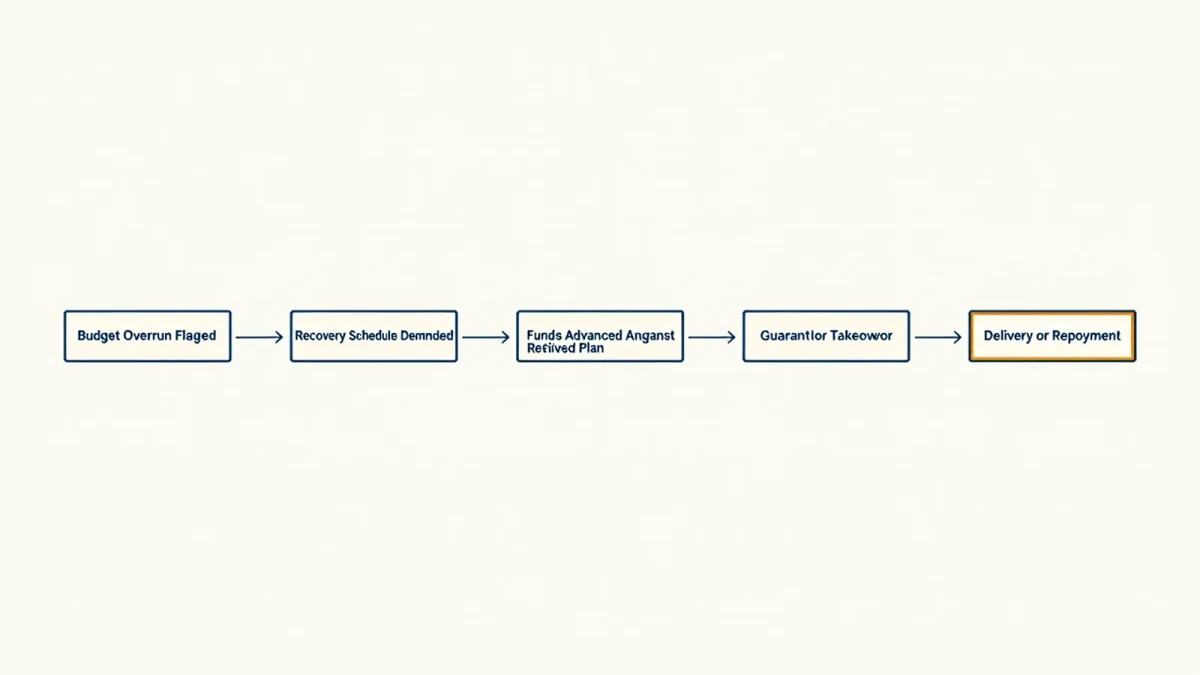
The completion bond sits on top of the whole structure. Financiers require one because every dollar described above is contingent on the film being delivered on budget and on schedule, and the guarantor is the party that promises delivery. The bond is examined in its own right elsewhere in this clinic, but no presale, gap loan or rebate locks until the bond is in place — it is the load-bearing wall of independent finance.
Who Really Controls an Independent Film?
Control follows the last dollar in and the first dollar out. Equity controls development; banks control cash flow against contracts; completion guarantors control overruns; distributors who paid minimum guarantees control final cut more often than directors do, through delivery requirements written in the acquisition agreement. A producer's skill is keeping the stack from noticing how much depends on each other.
The cascade has a smell test. When a financing plan requires the same collateral to back two loans, or counts a rebate at face value that trades at a discount, or books a presale from a distributor whose own credit is shaky, the plan is a spreadsheet illusion. Trade reporting on collapsed productions usually finds the same corpse: one territory's paper was doing three jobs.
How Does the Money Flow Back After Release?
Revenue lands in a waterfall, not a pool. The distributor recovers its advances and marketing costs first; the sales agent takes its commission; the bank retires the loan; the rebate was already netted at source; equity recoups 110 to 120 percent of its position; then deferrals, backend participants and profit definitions argue over what remains — which is often a rounding error, by design of the earlier definitions.
That is why the financing order is the whole game. The parties who accepted certainty early — banks, bond companies, rebate brokers — are paid before the parties who accepted risk. Equity's premium exists because it is the cushion under everyone else's arithmetic, and the film industry has never found a way to abolish that hierarchy, only to rename it.
What Should a Reader Take From All This?
Financing is allocation of doubt. Presales export risk to distributors, incentives import subsidy from taxpayers, debt converts contracts into cash, and equity buys the residue. A green light is simply the moment the sum of those commitments equals the budget number — and every party's incentive to say yes is someone else's discount.