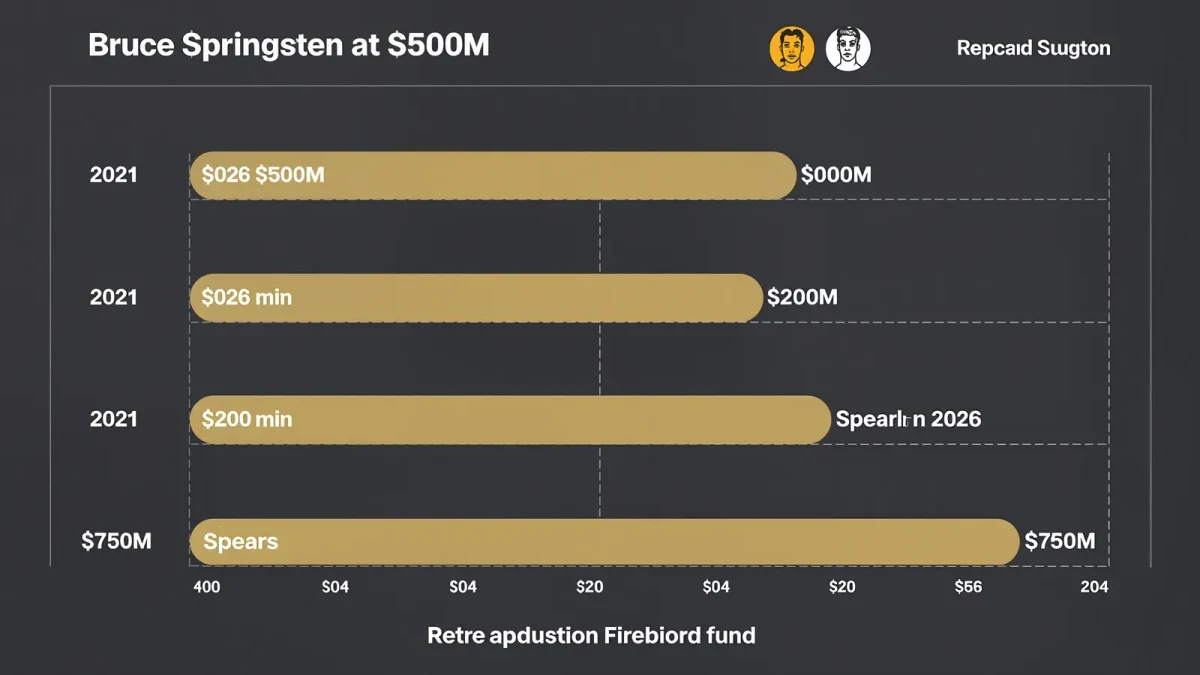
A celebrity catalog sale is the sale of rights to a body of work — publishing, recorded masters, or both — for a lump sum priced as a multiple of the catalog's annual royalty income. Bruce Springsteen sold his publishing and recorded-music rights to Sony Music Group in 2021 for a reported $500 million-plus, per Reuters, 2021, and Bob Dylan's publishing catalog went to Universal Music Publishing Group in 2020 in a deal reported above $300 million, per Reuters, 2020. The catalog became the asset class of the decade because low rates made predictable royalties look like bonds that sing.
This site publishes business information, not investment advice. Figures below are reported values, not official disclosures unless noted.
What Is Actually Being Sold?
Two separable products. Publishing rights cover the compositions — the songs as written, generating writer and publisher shares of mechanical, performance, and synchronization royalties. Masters cover the specific recordings, generating streaming, download, and licensing income. A star can sell one, the other, or both, in whole or in percentage. Justin Bieber's 2023 sale to Hipgnosis Songs Capital covered his publishing and recorded-music interests in a deal valued at about $200 million, per Reuters, 2023 — one catalog, two rights streams, one check.
Names, trademarks, and likeness are a third, newer layer: some sales bundle visual and brand rights with the music, which is why catalog buyers now talk about acquiring franchises, not just songs.
How Are Catalogs Valued?
By multiples of an established metric — typically NPS, net publisher's share, or the seller's net royalty income — applied against audited royalty history. Multiples vary with age of the catalog, durability of streaming, and buyer competition. Reported pricing during the 2020–2022 boom ranged broadly between roughly 10 and 20 times annual income for premium catalogs, per Billboard's coverage of catalog-valuation benchmarks, 2021. A catalog skewed to one era or one hit prices lower; a catalog that streams steadily across decades prices higher.
Buyers also discount for life factors: age of the seller, touring activity that promotes the works, and sync potential in film and advertising. The underwriting is actuarial — the buyer is buying decades of future royalties.
Why Did Everyone Sell at Once?
Tax and rates. Capital-gains treatment on a sale was, for U.S. sellers, more attractive than waiting for royalty income taxed as ordinary rates — a spread widely reported during the boom, per Bloomberg, 2021. Buyers, flush with private-equity and institutional money led by Hipgnosis and roundhill-style funds, bid catalogs up. Rising rates from 2022 deflated the bubble — Hipgnosis's portfolio was later revalued downward and the fund sold to Blackstone in 2024, per Reuters, 2024 — but the sale mechanism survived the cycle.
The other motivator is control and estate planning. A lump sum divides cleanly among heirs; a royalty stream divides into argument.
Who Are the Buyers?
Four groups. Legacy music companies — Sony, Universal, Warner — buy to own their distribution pipeline forever. Dedicated funds, including the Hipgnosis vehicle and its Blackstone-backed successor, buy portfolios for investors. Independent acquirers like Primary Wave specialize in buying iconic-name catalogs and brand rights. And exchange-traded royalty structures let smaller investors own fractions. Competition among these groups set the boom's prices.
Sony's 2024 acquisition of half of the Michael Jackson estate's stake in the Jackson catalog — a deal reported at valuation near $600 million or more, per Reuters, 2024 — showed the ceiling: the largest catalogs now trade like media companies.
What Does the Star Keep After Selling?
Negotiated residuals. Sellers commonly retain a songwriter's share of performance royalties where law or contracts allow, approval consultation on synch uses, and — in the best-structured deals — a reversion or participation if the buyer resells at a profit. What the star loses is control: the buyer decides whether a song licenses to a commercial, a film, or a political campaign, subject only to whatever consent rights were kept. Bob Dylan's subsequent sales of recorded catalogs and the dispute over his publishing deal's scope showed how contested those boundaries can be, per Reuters, 2024.
Reputation is not sellable. Buyers price the catalog; the public still attaches it to the artist, which is why some sellers negotiate morality-style restraints on uses that could damage their legacy.
What Are the Risks on Each Side?
The seller risks selling a rising asset — catalogs that kept growing after sale made their sellers look early and cheap. Streaming-rate changes, platform shifts, and AI-era consumption all move long-term royalty curves in ways a 2021 model could not fully price. The buyer risks overpaying: Hipgnosis's markdown proved that multiples written in a zero-rate world do not survive 5 percent treasury yields. Both sides carry interest-rate risk implicitly in every multiple struck.
Is the Window Still Open?
For premium catalogs, yes — the Jackson and Springsteen-era prices reset expectations, and well-capitalized buyers remain. For mid-tier catalogs, multiples have compressed and buyers are pickier, favoring evergreen streaming over nostalgia plays. The market matured: from land rush to underwriting discipline in four years.
How Long Does a Sale Take?
Months. A serious process starts with a data room: audited royalty statements, streaming breakdowns by territory and platform, sync history, and existing contract obligations. Buyers model curves, submit bids or exclusivity offers, and negotiate retained rights and reversion terms. The seller's business manager coordinates tax structuring, which can be the slowest part of the entire transaction. Diligence, not negotiation, is where most deals quietly die.
Frequently Asked Questions
How much did the biggest catalog sales raise?
The reported benchmarks: Springsteen's $500 million-plus Sony deal in 2021, Dylan's publishing at above $300 million in 2020, Bieber's roughly $200 million Hipgnosis deal in 2023, and Sony's purchase of half the Jackson estate's stake at a reported $600 million-plus valuation in 2024 — all per Reuters in the respective years.
Why do buyers pay 15 or 20 years of royalties upfront?
Because they expect to collect far longer than that. A durable catalog streams for decades, and buyers underwriting at 15–20 times income during the boom assumed near-bond-like durability, per Billboard, 2021. Cheap money made those multiples financeable; higher rates have since compressed them.
Does the artist still get paid after selling?
Usually something — retained performance-rights shares, consultation fees, or participation — but the royalty stream itself belongs to the buyer. What the artist definitively keeps is fame and the ability to perform, which is why touring income and catalog sales are separate decisions.
Are catalog prices falling?
The froth is gone. Rising rates repriced royalty assets, and Hipgnosis's portfolio markdown and 2024 sale to Blackstone, per Reuters, 2024, marked the correction. Iconic catalogs still command premium multiples; mid-tier ones no longer do.
Can a star sell only part of a catalog?
Yes — partial sales, percentage interests, and territory-by-territory splits are standard tools. Partial sales raise cash while keeping upside and some control; full sales maximize price and end the relationship.