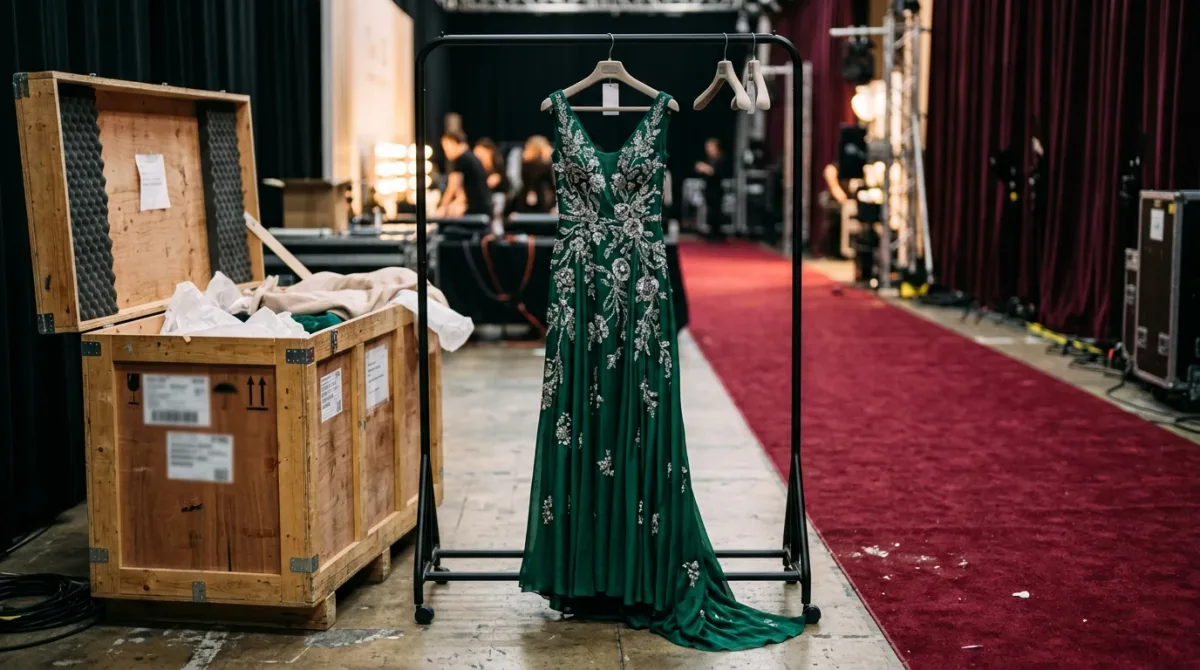
A celebrity's red carpet gown is almost never a purchase. It is loaned by a designer's PR team in exchange for exposure, and for A-list names it often comes with a separate fee on top, paid outside the loan itself, according to a Brooklyn Law School review of the practice published in May 2025.
The mechanics sound simple: a brand lends a dress, a photographer captures it, the internet reacts. In practice, the money and the paperwork behind that exchange are far less tidy than the finished photo suggests — and who gets paid what has been shifting for years.
How does the loan-and-return system work?
A stylist or celebrity selects a look from a designer's line sheet or lookbook ahead of an event, and the brand's own public-relations team then handles delivery, fittings, and the return, per Brooklyn Law School's Sports & Entertainment Law Blog.
If a garment comes back late, unworn as promised, or damaged, the arrangement can shift from a favor into a bill. "If something's gone unworn, late, or ruined, we'll enter invoice territory," a stylist told the blog for its May 2025 analysis.
The blog's central finding is that most of this runs on handshake terms. Formal contracts spelling out liability for damage, return deadlines, or compensation are the exception, not the rule, across both celebrity and digital-influencer loans, it found.
What does a brand get for lending out a dress?
Visibility that advertising budgets struggle to buy at the same speed. The Brooklyn Law School analysis cites one case in which Beyoncé's appearance in a Marine Serre bodysuit produced a 426% surge in global searches for the brand within 48 hours, with demand still climbing 51% week over week afterward.
That kind of spike is the entire economic logic of the loan system: a single worn look, captured by enough cameras, can outperform a paid campaign — which is also why brands are willing to go further than a free loan for the celebrities most likely to generate it.
When does a brand actually pay a celebrity to wear something?
Once a name is valuable enough to move sales, brands move from lending to paying a direct fee on top of the loan. Awards-season figures compiled by The Hollywood Reporter, drawn from stylists and brand representatives it surveyed directly, put single-appearance rates at:
| Category | Typical fee per appearance |
|---|---|
| Gown | $50,000–$200,000 |
| Jewelry | Up to $125,000 |
| Watch | $10,000–$25,000 |
| Handbag | $10,000–$15,000 |
| Shoes | $5,000–$10,000 |
Those figures date to the 2019 awards season; the underlying arrangement — a per-wearing or per-season fee stacked on top of the free loan — has not been reported to have changed, though the specific dollar amounts have not been independently re-surveyed since. A full-season ambassador contract with a major house could run into seven figures for the most in-demand stars, that reporting found. Beauty deals can start around $20,000 for a single sponsored post, and a full-season tuxedo contract with a major house has reached roughly $2 million for the most sought-after male stars, the same reporting found — figures that sit well above what most working actors earn from the film or show they are technically promoting.
Those numbers describe the top of the market: the handful of names a brand will pay to secure. They say nothing about what the stylist standing next to the celebrity is paid, and that figure has moved in the opposite direction.
Why are working stylists' fees falling as brand budgets grow?
Because the money changed hands from studios to brands, and brands don't pay stylists the way studios once did. "Brands hold the purse strings now. When I started doing this, movie companies paid," one veteran stylist said, in reporting on the state of Hollywood styling published by The Hollywood Reporter in April 2026.
The same reporting found that per-look styling fees have fallen as low as $500, even as hard costs like tailoring and shipping for a single outfit can run $3,500 — a gap stylists now cover by diversifying into social media partnerships, private clients, and advertising work rather than relying on red carpet day rates alone.
Kate Young, one of the industry's most established names, told the same publication she now earns less for press-tour work than she did fifteen years ago, despite the visibility those jobs generate for the films and shows involved.
The effect is a widening gap inside the same industry: ambassador fees for the celebrities themselves have stayed lucrative at the top, while the working stylists who build and execute the look absorb a shrinking day rate for the same labor.
Who is actually on the hook if something goes wrong?
Usually, it is unclear — and that is the gap both the legal review and the fee reporting point to from different angles. A loaned gown is typically an uninsured, informally tracked asset moving between a brand's showroom, a stylist's rack, and a red carpet, with no standard agreement covering who pays if it is lost, damaged, or reused commercially without permission.
The same review flags a second, related gap: when a loaned look is later reused commercially — in a paid social post, a brand campaign, or licensed merchandise — image rights and copyright ownership are rarely addressed up front, leaving both sides to negotiate after the fact rather than under agreed terms.
The Brooklyn Law School review recommends written agreements that spell out condition, return timelines, and compensation before a garment ever leaves the showroom. Until that becomes standard, the industry's most photographed transactions keep running on trust, invoices written after the fact, and fees that no longer track evenly with who is actually doing the work.
Frequently Asked Questions
- Do celebrities keep the dresses they wear on the red carpet? Not by default. Most red carpet looks are loans that return to the brand after the event, with keep-or-buy terms handled case by case rather than as a standard rule, per the Brooklyn Law School review of the practice.
- Is a stylist paid by the celebrity or the brand? Both, depending on the job. Studios historically covered styling costs for press tours, but Hollywood Reporter's 2026 reporting found brands now control more of that budget, with some stylists supplementing lower day rates with brand and social media work.
- How much can a top celebrity earn from a single red carpet appearance? Awards-season deals surveyed by The Hollywood Reporter in 2019 ranged from roughly $50,000 to $200,000 for a gown alone, with jewelry and full-season contracts adding significantly more for the most in-demand names.
- Are red carpet dressing deals legally binding contracts? Often not in a formal sense. The Brooklyn Law School analysis found many loan arrangements are handshake agreements without enforceable terms covering damage, late returns, or compensation.
- Why have stylist fees dropped even as brand marketing budgets around red carpets have grown? Because most of that budget growth flows to the celebrity's ambassador fee and the brand's own PR operation, not the stylist's day rate, according to Hollywood Reporter's April 2026 reporting on working stylists' finances.
For a related studios perspective, read How Overall Deals Work — and Why Writers Are Fighting to Save Them.