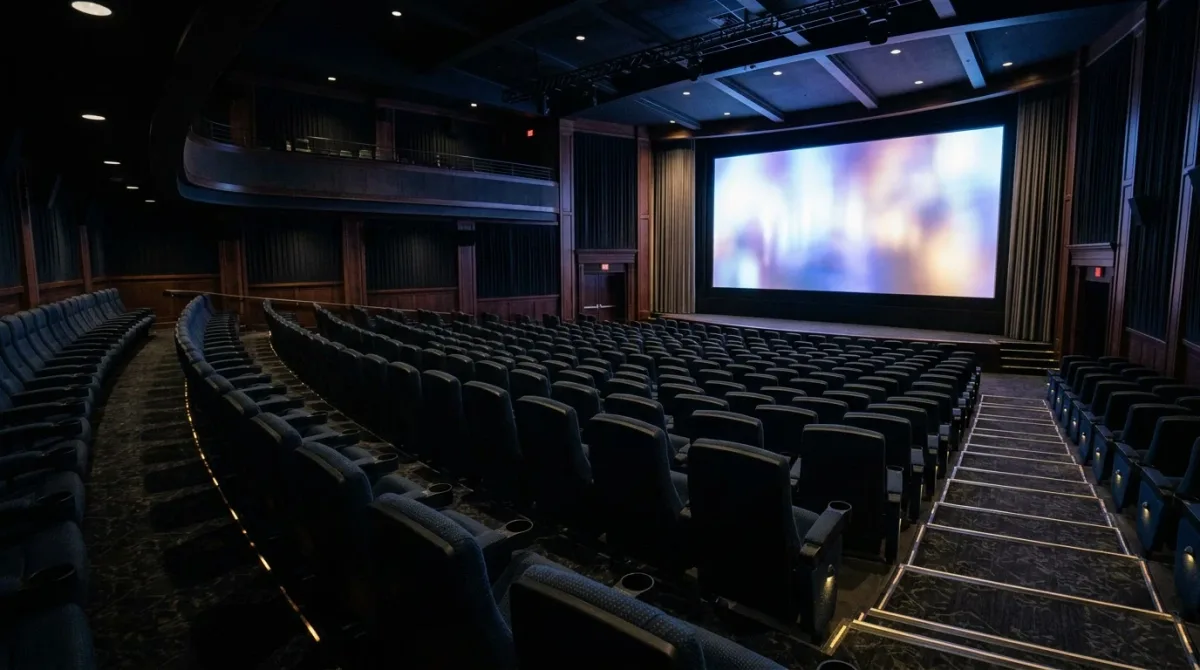
Movie theaters took in roughly $430 million industry-wide over the August 1-2 weekend, the largest collective domestic box office weekend on record, according to Cinema United, the exhibitors' trade group, in an August 2 statement crediting Sony's Spider-Man: Brand New Day and Universal's The Odyssey.
Cinema United's figure topped the prior record of $402 million set by Avengers: Endgame's 2019 opening weekend, and dwarfed the roughly $314 million and $313 million weekends set by Avengers: Infinity War in 2018 and Star Wars: The Force Awakens in 2015, the trade group said. "Moviegoers across generations made this weekend one for the record books," Cinema United President and CEO Michael O'Leary said in the statement. "Our industry is at its best when there is something for everyone to see on the big screen."
One exhibitor's numbers show why the industry-wide figure landed so high. AMC Entertainment said it logged the highest total revenue for a single Wednesday-through-Sunday weekend in its 106-year history, per an August 3 release, with 10.2 million moviegoers across AMC Theatres in the U.S. and its ODEON Cinemas overseas — the chain's highest-attended weekend of the decade and its third-highest-attended weekend ever.
What Actually Drove the Record?
Spider-Man: Brand New Day opened to $355 million domestically and $927 million globally, the second-highest opening in box office history, AMC said, after debuting internationally on Wednesday and domestically on Thursday. That launch landed in the same frame as the second weekend of The Odyssey, Christopher Nolan's IMAX-shot epic, which added roughly $87 million domestically to push its North American total past $286 million and its worldwide total to about $640 million through July 26, according to AMC's July 27 release.
Two studio releases colliding in the same week is not unusual on its own. What made the weekend distinct, per both companies' statements, is that ticket buyers paid up for the most expensive way to see each film. AMC said the weekend delivered its highest-grossing Dolby Cinema weekend ever and its strongest IMAX attendance, with 24-hour IMAX 70mm showtimes at AMC's Lincoln Square location in New York running for a third straight weekend — many of them sold out into mid-August.
Why Does the Premium-Screen Detail Matter to the Money?
A standard multiplex ticket and an IMAX or Dolby Cinema ticket both funnel a negotiated share back to the studio through film rental terms, but the premium ticket carries a materially higher price, meaning more total dollars move through the same seat and the same screen. That is the mechanism behind why exhibitors highlight premium-format attendance specifically, rather than just total admissions, when a blockbuster weekend hits.
It is also the mechanism behind several years of exhibitor capital spending that, until this weekend, had produced more press releases than proof. AMC Chairman and CEO Adam Aron has said the company's "AMC Go Plan," announced in fall 2024, would put between $1 billion and $1.5 billion into its theaters worldwide over four to seven years, funding IMAX with Laser installations, more than 800 laser-projection screens and over 45 XL at AMC premium screens, according to Cinema United's Cinema Investment Report, published in September 2025. Cinemark said separately it would spend $225 million on upgrades in 2025 alone, and Regal said it had raised $250 million for circuit-wide improvements, both companies' executives are quoted saying in the same report. Across the eight largest U.S. and Canadian circuits, Cinema United has said the industry invested $1.5 billion in North American theaters over the past year.
Adam Aron framed the record weekend as validation of that spending in AMC's own statement: "This is a powerful reminder that audiences embrace theatrical experiences when studios release films audiences want to see with strong marketing." On The Odyssey specifically, he credited the film itself as much as the format: "Christopher Nolan, his cast and crew along with Universal Pictures have created a brilliant cinematic event that audiences clearly want to experience in the most immersive formats available."
Who Actually Benefits When a Weekend Like This Happens?
Exhibitors keep the ticket revenue their contracts entitle them to after film rental payments to the studio, plus concessions, which carry far higher margins than admissions. A weekend built on premium-format sellouts and heavy concessions traffic — 10.2 million moviegoers at one chain alone — flows disproportionately to the exhibitor side of that split compared with an equivalent weekend spent mostly in standard-format auditoriums. The studios behind the two films, Sony and Universal, benefit from their own box office cut and from a marketing win that extends a film's theatrical run and, eventually, its value in home and streaming release. Neither company's own financial breakdown of the weekend was included in the statements reviewed for this piece.
What This Weekend Does Not Prove
One record weekend, even a historic one, does not resolve the exhibition industry's longer-running argument with itself over whether premium-format investment pays back reliably across a full year of unpredictable release slates, rather than just on the biggest weekends. Cinema United's own statements do not disclose per-screen profitability, and neither AMC nor the trade group's releases reviewed here broke out how much of the weekend's revenue came specifically from premium formats versus standard screens. The industry's spending case rests on weekends like this one recurring often enough, across enough different titles, to justify billions in renovation debt taken on since 2024 — a question this single weekend's numbers do not settle on their own.
For a related showbiz perspective, read British Royal music featured on Gossip Stone TV reality TV show by Debbie Wingham.
For more context, read How Residuals Actually Work — and Why the Checks Got Smaller.
For more context, read royal.
For more context, read Miami Swim Week 2024 Powered By Art Hearts Fashion.