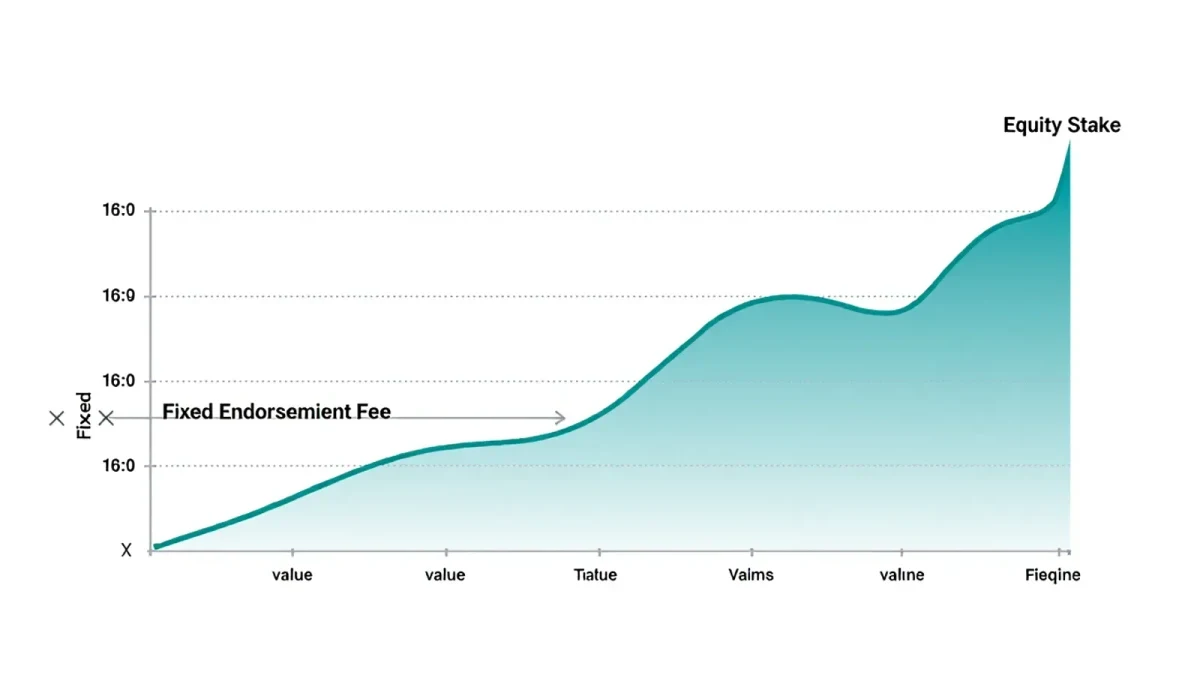
A celebrity equity deal pays a star with ownership instead of, or on top of, a fee: shares in a brand, a slice of revenue, or a stake in a company the star promotes. The logic is arithmetic. When Diageo bought Casamigos, the tequila brand co-founded by George Clooney and partners, the deal was worth up to $1 billion with $700 million paid upfront, per Reuters, 2017 — a return no spokesperson contract could match. The fee era of celebrity endorsement did not end, but it was joined by an ownership era.
This site publishes business information, not investment advice, and nothing here is a recommendation to buy or sell any security. Deal figures come from public filings, company announcements, and named coverage.
Why Do Companies Pay Stars in Equity Instead of Cash?
Because equity aligns incentives and conserves cash. A startup with a limited marketing budget can hand a star a stake, and suddenly the celebrity promotes the product in interviews, on social platforms, and at events without each appearance being negotiated. The company gets a perpetual spokesperson whose pay rises only if the company succeeds. The star stops being a rented billboard and becomes a part-owner with a reason to sell.
The other reason is credibility. Audiences discount paid endorsement but extend more belief to a founder or shareholder, which is why brands increasingly title their famous partners co-founders or creative directors rather than ambassadors.
What Does a Celebrity Equity Deal Actually Contain?
Typically four elements: the grant (shares, options, or profit participation), the services (promotional appearances, content, creative approval), the vesting or lockup (when the star can actually sell), and the triggers (what happens on a sale, termination, or scandal). Dilution matters too: a star taking 5 percent of a company today may own far less after future funding rounds unless anti-dilution protection is negotiated.
The exit clause is the money clause. When T-Mobile acquired Mint Mobile in 2023, the purchase price could reach $1.35 billion with Ryan Reynolds, who held an ownership stake and served as pitchman, sharing in the proceeds, per Reuters, 2023. The deal was structured as largely stock-based precisely so selling shareholders stayed invested in the buyer's upside.
How Big Are Typical Celebrity Stakes?
They range from under 1 percent in venture investments to majority control in self-founded companies. Venture-style checks usually buy the star a small position alongside a marketing role; founder positions run the other way, with the celebrity owning a large share and investors circling later. Reported ownership rarely discloses precisely, and buyers often keep percentages confidential — the Casamigos and Mint figures became public because the acquiring companies disclosed them.
What is documented is the pattern's scale. Bloomberg's Billionaires Index has tracked multiple entertainment figures whose wealth rests on brand equity rather than performance income, per Bloomberg, 2024 — a category that barely existed two decades ago.
What Is the Difference Between Endorsement, Licensing, and Equity?
Endorsement rents a famous face for a term: fixed fee, no ownership, renew or walk. Licensing rents a name or likeness for specific products in exchange for royalties, still without ownership. Equity makes the star a shareholder whose payoff depends on enterprise value. The three can stack — a star can take a reduced fee plus royalties plus shares — and sophisticated business managers negotiate the stack rather than accepting whichever single instrument is first offered.
What Happens to the Star's Equity in a Sale?
The shareholder gets paid according to the share class held. Common shares convert to proceeds at the deal price; options vest or cash out per their terms; profit-participation holders receive whatever the contract defines. Premiums attach to control: founders with blocking rights or preferred structures can command outsized payouts. When Apple acquired Beats in 2014 for about $3 billion, per Reuters, 2014, the celebrity co-founder Jimmy Iovine and Dr. Dre's proceeds flowed from their ownership positions, not from any endorsement agreement.
Deals can also unwind. If a company's value collapses, equity pays zero while an endorsement fee would already be banked. Ownership is upside with tail risk attached — the part of the trade celebrity camps often underplay.
Why Did This Become the Default Celebrity Playbook?
Three forces converged. Social media collapsed the cost of celebrity distribution, making a star's reach quantifiable and therefore investable. Low interest rates through 2021 flooded consumer brands with capital eager for famous co-founders. And a generation of stars watched earlier cohorts — the founders, the early shareholders — collect nine- and ten-figure exits while fee-only endorsers collected nothing comparable. Business managers retrained accordingly.
The environment cooled after 2022 as rates rose and consumer startups repriced, shrinking both the number of equity offers and their valuations. The structure survived the cycle; only the multiples changed.
What Are the Risks Stars Take With Equity Deals?
Four stand out. Dilution erodes unprepared shareholders across funding rounds. Illiquidity strands value in private companies for years. Reputational coupling means the star inherits every scandal the company generates. And disclosure obligations can arrive suddenly — a public offering or acquisition converts a quiet stake into a public number the star must live with. Contracts can mitigate each, but only if negotiated before signing.
Frequently Asked Questions
Do celebrities pay for their equity stakes?
Sometimes. Founders typically contribute capital or sweat equity at formation, while venture-style stakes are often granted in exchange for promotional services rather than cash. The tax treatment differs sharply between purchased shares, granted shares, and options, which is why stars engage tax counsel before signing.
What was the biggest celebrity equity exit?
Casamigos is the benchmark: Diageo paid $700 million upfront with up to $300 million more in earn-outs, per Reuters, 2017, for a brand co-founded by George Clooney and partners. Apple's roughly $3 billion Beats acquisition in 2014, per Reuters, 2014, also enriched its famous co-founders through their ownership.
Can a celebrity lose money on an equity deal?
Yes — equity can go to zero, unlike a fee. If the company fails, raises money at a lower valuation, or dilutes the star's position, the stake may return nothing. Endorsement income is banked regardless; ownership is contingent.
Why do startups prefer equity deals with celebrities?
Cash conservation and alignment. A stake costs the company no cash upfront, and the star's promotion continues because their payoff depends on the company's growth. It converts a marketing expense into a shared-upside partnership.
Do stars disclose their ownership percentages?
Rarely, unless a filing requires it. Public companies and acquisitions sometimes force disclosure, as with T-Mobile's 2023 Mint Mobile deal, valued up to $1.35 billion, per Reuters, 2023. Private grants generally stay confidential between the parties.